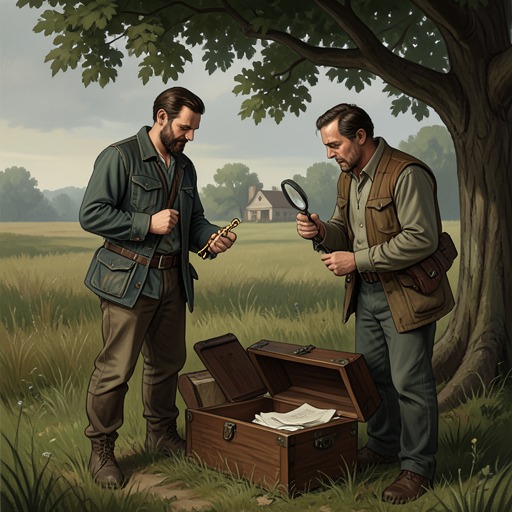
Luke Hadler’s shotgun
The DryLuke Hadler’s shotgun is both the apparent instrument of the Hadler family murders and one of the central objects that unsettles the first explanation of them. Its ownership, recovery, ammunition, and fingerprints seem at first to support a clear account, but details examined by Greg Raco and Aaron Falk make the weapon less conclusive than it appears.
Identity and storage
The shotgun belonged to Luke Hadler, and the early public account treated that fact as part of a straightforward explanation of the deaths. Aaron Falk, present as a friend rather than as an investigator, had heard the same account as everyone else: the weapon was Luke’s, and it had been recovered with him. The connection between owner and firearm initially appeared to close the question of how the killings had been carried out.
At Hadler Farm, however, the shotgun had not simply been left within easy reach. Greg Raco says Luke normally kept it in a secured lockbox in the barn. The Winchester ammunition Raco found was stored separately and locked away as well. That arrangement makes the weapon’s presence at the crime scene distinct from the ordinary, carefully controlled way Luke stored it. It also gives the investigation a practical question to pursue: whether the firearm’s documented use and the ammunition available on the property fit together.
Use in the killings and recovery
The forensic account identifies Luke’s shotgun as the weapon used in all three deaths. The weapon was licensed and registered, and Luke’s fingerprints were the only ones found on it. Those details lend weight to the initial assumption that Luke used his own firearm. The story does not present the weapon’s ownership as uncertain; the difficulty lies in what the surrounding evidence can, and cannot, establish about its use.
The firearm enters the investigation through the search for Luke. After he could not be reached, searchers and police looked through fields and bushland, concerned that he might be alive and armed. A search volunteer eventually found Luke’s truck in a clearing about three kilometres away. Luke was dead in the vehicle, and his own licensed, registered gun was still in his hand. The recovery therefore joined three facts that seemed mutually reinforcing: the weapon belonged to Luke, he was found with it, and it was identified as the weapon used in the killings. Yet this apparent completeness is precisely what later evidence begins to complicate.
Ammunition and fingerprints
Greg Raco identifies the cartridges as a discrepancy. The three shots used in the killings were Remington, whereas the only ammunition Raco could find on the property was Winchester. Raco understood that Luke had used another brand for years. The contrast is not a minor variation in the weapon’s storage: the firearm was Luke’s, but the ammunition associated with the killings did not match the Winchester stock found at Hadler Farm. The evidence establishes that mismatch without, by itself, explaining how it arose.
The fingerprint report adds a separate uncertainty. It showed six clear impressions and two less distinct ones, with the latter still identified as Luke’s left thumb and right little finger. Aaron Falk considers the prints unusually solid for a man presumed to have killed his family. He contrasts their clarity with what he would expect from fingerprints taken under evidence conditions after such an event, and suggests that they may be almost too clear. Greg Raco recognizes the implication and looks again at the report. The prints remain identified as Luke’s; the question raised is not whose they are, but whether their condition fits the presumed circumstances in which they were left.
Investigative and narrative significance
Together, the ammunition and fingerprint evidence shift the shotgun from apparent proof toward a problem requiring further inquiry. Ownership and recovery make the initial account persuasive, while the Remington rounds, the Winchester ammunition on the property, and the unusually clear impressions resist a simple reading. None of these details alone supplies an alternative account of the deaths. Their force comes from the gap between what the firearm seems to settle and what its associated evidence leaves unresolved.
The object also concentrates the distinction between a visible conclusion and a tested one. At first, the gun’s connection to Luke appears to make the case nearly self-explanatory. Falk’s examination of the fingerprint report and Raco’s discovery about the cartridges instead turn familiar forensic facts into questions about consistency. The shotgun remains Luke’s, and the investigation identifies it as the weapon used in all three killings, but those established facts no longer make the circumstances self-evident. Its importance lies in that reversal: the firearm that seemed to confirm the case becomes one of the reasons Falk and Raco cannot treat the original account as finished.